
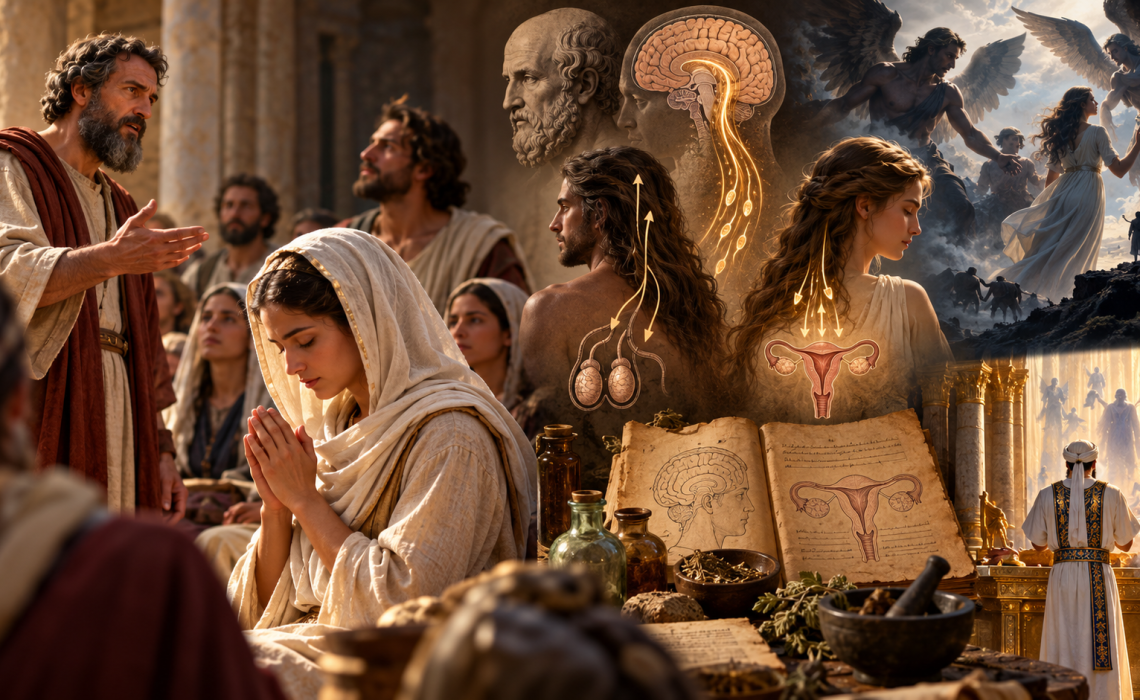
“Judge for yourselves: is it proper for a wife to pray to God with her head uncovered? Does not nature itself teach you that if a man wears long hair it is a disgrace for him, but if a woman has long hair, it is her glory? For her hair is given to her for a covering.” — 1 Corinthians 11:13–15, ESV
Have you ever wondered why the Apostle Paul instructed women to cover their heads during worship while discouraging men from wearing long hair? And what did he mean when he said women should do this “because of the angels” (1 Corinthians 11:10)?
These instructions have puzzled Christians for centuries. But an unusual explanation emerges when we examine what people in Paul’s time believed about human anatomy, sexuality, and reproduction.
And the explanation is stranger than you might imagine.
The Strange Science of the Ancient World
In 2004, biblical scholar Troy W. Martin published an article in the Journal of Biblical Literature titled Paul’s Argument from Nature for the Veil in 1 Corinthians 11:13–15: A Testicle Instead of a Head Covering.
Martin proposed that Paul’s instructions reflected ancient Greek medical theories, particularly those associated with Hippocrates and Aristotle.
According to these theories, hair was directly connected to reproduction.
Ancient physicians believed that hair consisted of hollow structures that attracted and absorbed reproductive fluids. Semen supposedly originated in, or was stored in, the brain before travelling through the body.
Men were thought to possess hotter bodies that propelled semen outward. Women, whose bodies were supposedly colder, absorbed and retained reproductive fluids.
Long hair therefore had different reproductive functions in men and women.
For women, long hair supposedly helped draw semen inward, assisting conception. For men, however, long hair supposedly pulled semen upward, preventing its proper release.
This explains, Martin argues, why Paul considered long hair natural for women but disgraceful for men.
Of course, modern medicine has demonstrated that these theories are completely mistaken. But they formed part of the medical understanding available in the ancient Mediterranean world.
Was Women’s Hair Considered Sexual Anatomy?
Here the argument becomes particularly fascinating.
Ancient medical writers sometimes understood women’s hair as functionally connected to their reproductive organs.
Hippocratic physicians even devised fertility tests based on this belief. One involved placing a scented substance inside a woman’s reproductive tract and checking whether its smell reached her mouth. If it did, she was considered fertile. If not, physicians assumed that internal passages were blocked.
Women also removed pubic hair, sometimes by singeing, partly because ancient theories associated this practice with fertility.
These ideas sound absurd today, but they illustrate how closely ancient people connected hair with reproduction.
Martin therefore suggests that Paul’s instructions concerning head coverings were fundamentally about modesty.
If women’s hair was understood as part of their sexual anatomy, displaying it during worship could be considered inappropriate.
Jewish religious traditions already prohibited exposing one’s nakedness during sacred service. Exodus 20:26, for example, forbids exposing nakedness while ascending God’s altar. Priestly undergarments served a similar concern, while Isaiah 6 depicts heavenly beings covering themselves.
From this perspective, Paul’s instruction becomes understandable: worshippers should approach God modestly.
But What About the Greek Word?
The Greek word peribolaion, translated “covering” in 1 Corinthians 11:15, is central to Martin’s argument.
He observes that related Greek terminology could refer to testicles in certain ancient literary contexts.
Martin consequently proposes that Paul was contrasting female hair with male reproductive anatomy.
Women possessed long hair as a functional reproductive counterpart to male testicles, according to ancient physiology.
This interpretation is disputed. Biblical scholar Mark Goodacre challenged Martin’s reading, and Martin subsequently defended it through additional ancient sources.
The debate demonstrates why reconstructing the original cultural setting matters, while also reminding us that an intriguing interpretation is not necessarily established fact.
Why Does Paul Mention Angels?
Another mystery appears in verse 10, where Paul says women should observe the instruction “because of the angels.”
One possible explanation connects this statement with Genesis 6:1–4, where the sons of God take human women.
In ancient Jewish literature, particularly 1 Enoch, this episode developed into the story of rebellious heavenly beings called the Watchers, whose transgression contributed to the corruption of humanity.
Scholar Loren Stuckenbruck has also explored connections between angelic traditions and Paul’s discussion.
Within this interpretation, Paul may have regarded appropriate sexual boundaries and modesty as especially important because of the earlier transgression involving heavenly beings and human women.
This remains debated, but it fits a broader biblical understanding of evil.
Scripture identifies three major rebellions: humanity’s disobedience in Genesis 3, the heavenly rebellion associated with Genesis 6, and the scattering of nations at Babel in Genesis 11, interpreted alongside Deuteronomy 32:8–9.
Together, these events explain the spread of human and supernatural rebellion.
What Does This Mean for Christians Today?
If Paul’s argument depended partly on ancient reproductive theories, Christians need not preserve those mistaken scientific assumptions.
The underlying principle, however, remains meaningful: worship should reflect modesty, dignity, and reverence.
Cultural expressions of modesty may change without necessarily abandoning that principle.
And perhaps the larger lesson concerns biblical interpretation itself.
We often read Scripture through modern assumptions, forgetting that its authors inhabited a radically different intellectual world.
Understanding the Bible sometimes requires understanding not merely what ancient people believed about God, but also what they believed about nature, medicine, sexuality, and the unseen world.
The challenge is to distinguish the enduring theological principle from the ancient worldview through which that principle was expressed.
Discover more from NUN HRUAITU
Subscribe to get the latest posts sent to your email.