
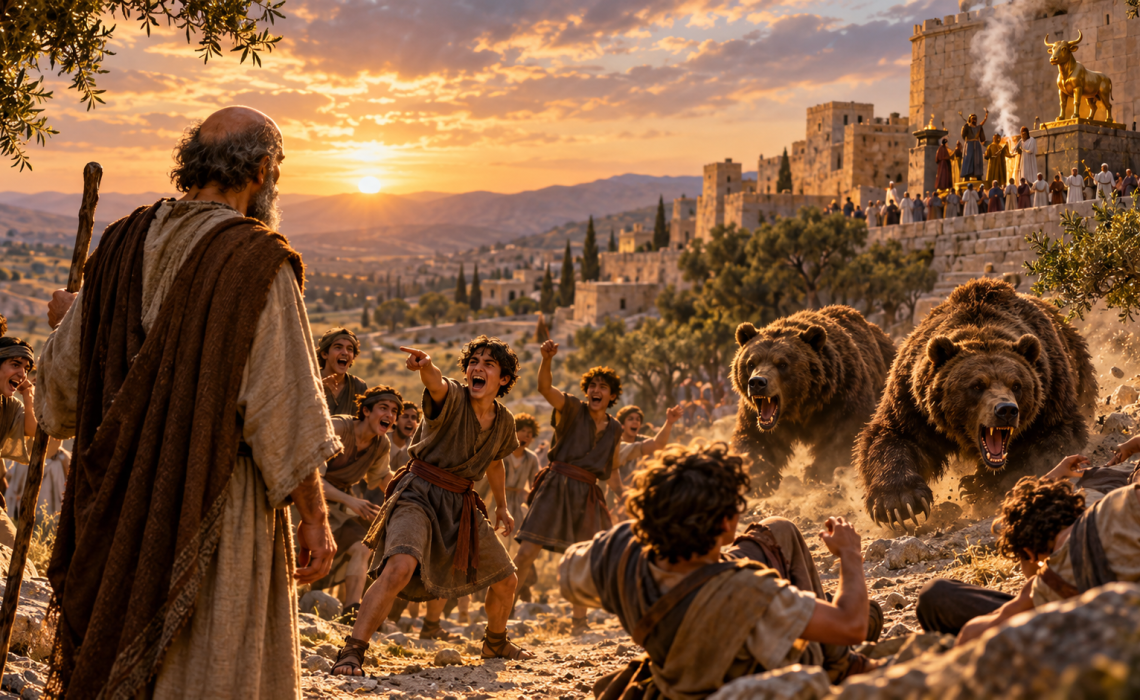
“He went up from there to Bethel, and while he was going up on the way, some small boys came out of the city and jeered at him, saying, ‘Go up, you baldhead! Go up, you baldhead!’” — 2 Kings 2:23 (ESV)
Have you ever encountered a Bible story that made you wonder, “What on earth is going on here?”
One of the strangest appears in 2 Kings 2:23–24. The prophet Elisha is travelling toward Bethel when some young people mock him, calling him baldheaded and shouting, “Go up!” Elisha curses them in the name of the Lord, and two female bears emerge from the woods and maul forty-two of them.
It sounds like an extraordinarily harsh punishment for a childish insult. Was Elisha really so offended by a joke about his baldness?
Perhaps we have misunderstood the story.
To appreciate what is happening, we need to examine its geography, Hebrew vocabulary, religious background, and place within the larger biblical narrative.
Why Bethel Matters
The first clue is Bethel itself.
The name means “House of God.” Jacob encountered God there and named the place Bethel (Genesis 28:19). But centuries later, the town became associated with religious rebellion.
After Israel divided into two kingdoms, Jeroboam I established rival worship centres at Bethel and Dan, placing golden calves there (1 Kings 12:28–29). Bethel consequently became a symbol of the northern kingdom’s corrupted worship.
This is what scholars sometimes call sacred geography or cosmic geography: places carry theological significance because of their associations with divine presence, worship, or competing spiritual loyalties.
Jerusalem represented Yahweh’s chosen sanctuary. Bethel, despite its sacred history, had become associated with religious apostasy.
There is also a curious geographical detail.
In 2 Kings 2:2, Elijah and Elisha travel from Gilgal to Bethel, using a Hebrew verb meaning “go down.” Yet if Gilgal refers to the familiar site in the Jordan Valley, Bethel lies uphill.
Why describe an upward journey as going down?
Perhaps another Gilgal is intended. But some interpreters suggest a theological meaning: travelling toward apostate Bethel symbolically represents spiritual descent.
This remains speculative, but the repeated language of ascending and descending throughout the chapter makes the possibility intriguing.
Were They Really Little Children?
Many readers imagine small children teasing an elderly prophet. But the Hebrew is less straightforward.
The expression translated “small boys” is ne’arim qetannim.
The noun na’ar can describe a child, adolescent, servant, or young adult. Joseph is called a na’ar at seventeen (Genesis 37:2). Solomon describes himself using na’ar qaton when he is already king (1 Kings 3:7).
Verse 24 uses another word, yeladim, which can also refer to young people rather than necessarily small children. In 1 Kings 12:8–10, related terminology describes Rehoboam’s younger advisers.
Therefore, Elisha’s opponents could have been adolescents or young adult males.
Some interpreters suggest they were associated with Bethel’s religious or royal establishment. That cannot be established from the text, but it is possible that this confrontation involved more than innocent children playing a prank.
What Did “Go Up, You Baldhead!” Mean?
The Hebrew verb qalas, describing their behaviour, conveys contempt or derision.
But why shout “Go up”?
One possibility connects the taunt with Elijah’s recent departure. Just before this incident, Elijah had ascended into heaven in a whirlwind (2 Kings 2:11).
The insult might therefore mean, “Why don’t you go up like Elijah?”
In other words, they were mocking Elisha’s legitimacy as Elijah’s successor.
Another interpretation connects the words with Bethel itself. Since Elisha was approaching a centre of apostate worship, the command could carry the implication that he should associate himself with Bethel’s religious establishment.
Under this reading, the confrontation becomes a challenge to Elisha’s loyalty to Yahweh.
Even “baldhead” may have a deeper significance.
Elijah is described as a hairy man, or possibly someone wearing a garment of hair (2 Kings 1:8). Calling Elisha baldheaded could deliberately contrast him with Elijah, suggesting he was an unworthy successor.
None of these interpretations is certain. Nevertheless, the insult may have concerned prophetic authority rather than merely physical appearance.
Why Forty-Two?
The story becomes more disturbing when two female bears maul forty-two of the young people.
Notice something important: the passage says they were mauled, not explicitly that all forty-two died.
The number forty-two also appears in 2 Kings 10:14, where Jehu kills forty-two men associated with Judah’s royal family.
Some interpreters suggest a literary connection between these incidents, both occurring within narratives concerning judgment upon corrupt religious and political establishments.
There is another parallel.
In 2 Kings 1, royal captains repeatedly command Elijah to “come down.” In 2 Kings 2, Elisha’s opponents repeatedly command him to “go up.”
These verbal echoes may be deliberate.
Still, we should resist assigning definite symbolic meanings to every detail. The biblical writer does not explain why there were precisely forty-two victims or two bears.
What matters is that the narrator presents the incident as judgment associated with Yahweh’s authority, not simply Elisha losing his temper.
Elisha, Moses, and Joshua
The larger narrative provides another important clue.
Elijah and Elisha repeatedly resemble Moses and Joshua.
Moses parts the Red Sea. Joshua leads Israel across the Jordan. Elijah divides the Jordan with his mantle, and Elisha repeats the miracle after Elijah’s departure.
Just as Joshua succeeds Moses, Elisha succeeds Elijah.
Both successors must be recognised as legitimate bearers of divine authority.
The geography reinforces these connections. Jericho, Gilgal, the Jordan, and Bethel feature prominently in Joshua’s narratives.
Jericho recalls divine victory. The defeat at Ai, near Bethel, illustrates the consequences of disobedience. Bethel later becomes associated with institutionalised idolatry.
Elisha’s ministry therefore stands within Israel’s larger history of covenant faithfulness and rebellion.
Three Miracles, Three Revelations
Consider Elisha’s first three miraculous acts following Elijah’s departure.
First, he divides the Jordan River (2 Kings 2:13–14), confirming his succession to Elijah.
Second, he heals Jericho’s polluted water (2 Kings 2:19–22), demonstrating divine restoration and blessing.
Third, the bears attack near Bethel (2 Kings 2:23–24), revealing divine judgment.
Notice the progression.
At the Jordan, prophetic authority is confirmed. At Jericho, that authority brings life. Near Bethel, rejection of that authority brings judgment.
The contrast is striking.
Jericho receives restoration. The hostile group from Bethel encounters judgment.
The same God who blesses also judges.
This theme runs throughout Scripture. Divine holiness cannot be reduced to kindness alone; it also confronts rebellion and evil.
Does This Point Toward Jesus?
There is an interesting theological parallel with Jesus.
Like Elisha, Jesus performs miracles demonstrating God’s restorative power. He heals the sick, restores the broken, and gives life.
Yet Jesus also confronts religious corruption.
In Matthew 23, he condemns religious hypocrisy. In Luke 19:41–44, he laments over Jerusalem and warns of its coming destruction.
The comparison is an analogy, not an explicit prophecy about Christ.
Nevertheless, both ministries reveal that divine authority involves mercy as well as judgment.
What Should Christians Learn?
We should acknowledge that the incident remains troubling. Understanding its background does not eliminate every moral question about the severity of the judgment.
But it does challenge the assumption that this was merely a prophet punishing children for mocking his appearance.
The story belongs to a larger struggle between faithfulness to Yahweh and Israel’s corrupted religious institutions.
And perhaps its most unsettling lesson concerns Bethel itself.
Bethel still meant “House of God.” It possessed sacred history, religious institutions, and the language of worship. Yet it had become associated with practices the biblical writers condemned.
That possibility should concern Christians today.
Churches can preserve impressive buildings, respected traditions, elaborate ceremonies, and familiar theological language while gradually losing their commitment to God’s truth.
Religious identity is not necessarily the same as spiritual faithfulness.
The story also reminds us that Scripture deserves careful reading. Geography matters. Hebrew vocabulary matters. Historical circumstances matter. Literary connections matter.
Above all, the passage invites us to consider whether our loyalty belongs to God himself or merely to institutions claiming his authority.
Because Bethel retained its sacred name long after its worship had become corrupted.
A place can still be called the House of God without remaining faithful to the God whose name it bears.
Discover more from NUN HRUAITU
Subscribe to get the latest posts sent to your email.