
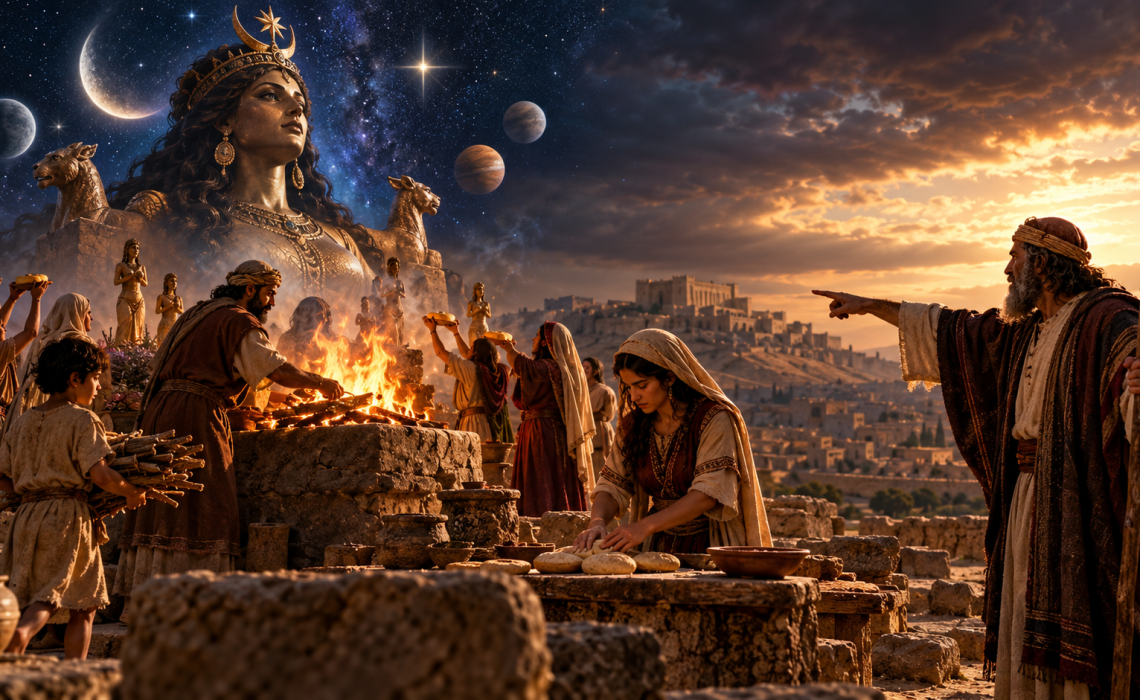
“The children gather wood, the fathers kindle fire, and the women knead dough, to make cakes for the queen of heaven. Is it I whom they provoke? declares the LORD. Is it not themselves, to their own shame?” Jeremiah 7:18–19 (ESV)
Have you ever come across something in the Bible that makes you stop and wonder what you’ve just read? In Jeremiah, God condemns the people of Judah for worshipping someone called the “Queen of Heaven.”
And here’s what’s fascinating. This wasn’t some secret ceremony. Entire families participated. Children gathered firewood, fathers lit fires, and women baked cakes in her honour.
So who was this mysterious Queen of Heaven? And how did people who were supposed to worship Yahweh end up worshipping her?
Before answering, there’s an intriguing linguistic puzzle.
Almost every English Bible translates the expression in Jeremiah 7 and 44 as “Queen of Heaven.” Yet the traditional Hebrew Masoretic Text has an unusual word, meleket (מְלֶכֶת), rather than the expected construct form for “queen,” malkat (מַלְכַּת).
Now, this is where things get interesting.
Ancient Hebrew was originally written without vowel marks. These were added centuries later by Jewish scribes called the Masoretes. The consonants in Jeremiah are MLKT, which can be understood as “queen” when supplied with the appropriate vowels.
But the Masoretes supplied vowels producing meleket, a pronunciation resembling mele’khet (מְלֶאכֶת), meaning “work.” Notice, however, that the ordinary Hebrew word for “work” contains an additional consonant, aleph. It isn’t simply the same word.
Some scholars suspect that the scribes deliberately altered the pronunciation to avoid acknowledging Israel’s worship of a pagan goddess. Others consider the unusual form a legitimate variation of “queen.” We cannot establish the scribes’ intentions.
Ancient translations complicate matters further. The Greek Septuagint refers to the heavenly host in Jeremiah 7 but to a heavenly queen in Jeremiah 44. A later Aramaic translation refers to the stars, while the Latin Vulgate and other ancient Greek versions support “Queen of Heaven.”
Could Jeremiah have meant the worship of stars and planets rather than a goddess?
Possibly. Ancient Near Eastern religions frequently associated heavenly bodies with divine beings. Amos 5:26, for example, refers to objects associated with astral worship.
Nevertheless, Jeremiah 44 speaks of offerings made to “her,” strongly suggesting a goddess. So “Queen of Heaven” remains a persuasive translation.
But which goddess?
Three candidates stand out: Anat, Ishtar, and Astarte.
Let’s begin with Anat.
If you imagine ancient goddesses as gentle, nurturing figures, Anat will surprise you. She was an ancient West Semitic goddess whose worship can be traced to the early second millennium BC, possibly earlier.
Ugaritic literature portrays her as a terrifying warrior who delighted in slaughter, even wading through the blood of defeated warriors. She was closely associated with Baal and possessed exalted titles resembling “Mistress of the Highest Heavens.”
There’s another intriguing connection. Fifth-century BC documents from the Jewish community at Elephantine in Egypt mention names such as Anat-Bethel and Anat-Yahu.
Remember, Jeremiah 44 addresses Judeans living in Egypt. Anat was also worshipped in Egyptian religious circles, and archaeological evidence from Beth Shean confirms her presence in Egyptian-influenced regions.
Could she have been Jeremiah’s Queen of Heaven?
Possibly. But evidence for widespread Anat worship in Judah during Jeremiah’s lifetime is limited.
The second candidate is Ishtar, one of Mesopotamia’s most powerful goddesses.
Worshipped throughout Assyria and Babylonia, Ishtar represented love, sexuality, warfare, and political power. In the Epic of Gilgamesh, she proposes marriage to the hero, then responds with destructive fury when rejected.
But the strongest clue connecting Ishtar to Jeremiah involves something surprisingly ordinary: cakes.
The Hebrew word for these ritual cakes, kawwanim, appears related to the Akkadian kamānu, used for cakes in Mesopotamian religious settings.
Some scholars speculate that the cakes were shaped like the goddess herself. Archaeologists have also discovered numerous female figurines in ancient Judah, although their precise significance remains debated.
However, kamānu wasn’t exclusively associated with Ishtar. So the connection is suggestive rather than conclusive.
Our third candidate is Astarte, a prominent Canaanite and Phoenician goddess closely related to Ishtar.
Unlike the others, Astarte appears by name in the Old Testament, usually as Ashtoreth or Ashtaroth.
Why the different pronunciation?
Biblical writers sometimes altered pagan names to express contempt. This practice is called dysphemism, the opposite of a euphemism.
Astarte’s name appears to have acquired vowels associated with boshet, the Hebrew word for “shame.”
Something similar happens with Saul’s son, called Eshbaal, meaning “man of Baal,” in Chronicles (1 Chronicles 8:33; 9:39), but Ishbosheth, meaning “man of shame,” in Samuel (2 Samuel 2:8–10). Mephibosheth (2 Samuel 4:4; 9:6) provides another related example, appearing as Merib-baal in Chronicles (1 Chronicles 8:34; 9:40).
Astarte is especially plausible because her worship belonged to the Canaanite religious environment surrounding Israel.
But perhaps we’re asking the wrong question.
What if the Queen of Heaven wasn’t one particular goddess?
Judges 2:13 says Israel served “the Baals and the Ashtaroth.” Notice the plurals.
These could simply be collective terms for foreign gods and goddesses, as similar expressions were used in Akkadian. But they might also reflect regional variations of the same deities.
Ancient religions frequently borrowed from one another. Greek Zeus and Roman Jupiter, for example, became closely identified without their traditions being identical.
Perhaps the Israelites developed their own version of the Queen of Heaven, combining characteristics of Anat, Ishtar, Astarte, and local religious traditions.
Scholars call this blending of religious beliefs syncretism.
That might explain why identifying her conclusively remains so difficult.
One misunderstanding also deserves attention. Roman Catholic tradition calls Mary the Queen of Heaven, prompting some Protestants to use Jeremiah against Marian devotion. But Jeremiah was addressing ancient pagan worship centuries before Christianity existed. Whatever one’s theological disagreements about Mary, identical titles don’t establish identical religious identities.
Yet perhaps the most important lesson lies elsewhere.
In Jeremiah 44, the people actually defend their goddess worship. When they honoured her, they claim, they prospered. When they stopped, disaster followed.
Their argument was simple: It worked, so why abandon it?
Doesn’t that sound familiar?
Even today, Christians sometimes confuse prosperity with God’s approval. We assume that wealth, success, or growing congregations demonstrate divine blessing.
But Jeremiah challenges that reasoning. The people’s suffering resulted from disobedience to Yahweh, not from neglecting the goddess.
And there’s another warning here.
Religious compromise doesn’t necessarily begin with consciously rejecting God. Sometimes it develops through familiar customs, inherited traditions, and practices nobody thinks to question.
The people Jeremiah confronted were deeply religious. They had ceremonies, offerings, and traditions. Their problem wasn’t a lack of religion, but religion that had become disconnected from faithfulness to God.
For Christians today, the lesson is not merely to avoid worshipping false gods. It’s to examine what commands our deepest loyalty, whether we judge truth by success, and whether our religious traditions genuinely reflect Scripture.
Perhaps the most revealing detail is that Jeremiah never explains who the Queen of Heaven was.
Apparently, his audience already knew.
And that’s the disturbing part. Worshipping another deity had become so ordinary that entire families participated without questioning it.
The tragedy wasn’t simply that Israel worshipped another goddess. It was that Israel had become so comfortable with its religion that it had forgotten the God it was supposed to worship.
And perhaps the question Christians should ask themselves is this: Have we become so comfortable with our own religious practices that we no longer stop to ask whether they truly honour God?
Discover more from NUN HRUAITU
Subscribe to get the latest posts sent to your email.