
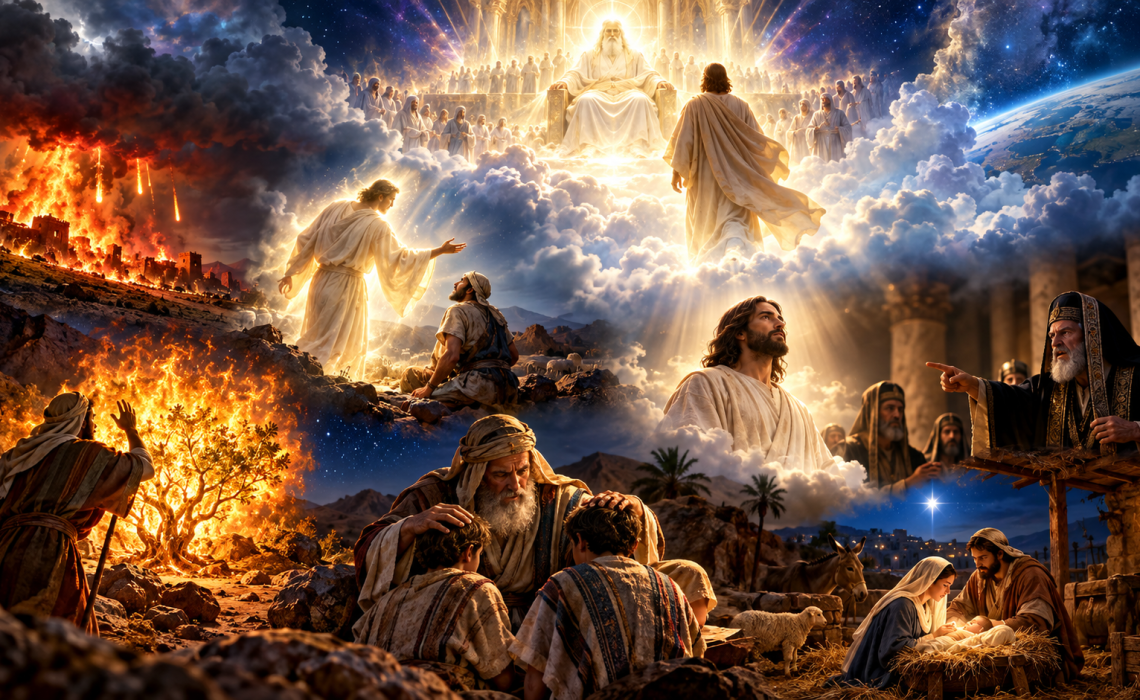
“I saw in the night visions, and, behold, one like the Son of man came with the clouds of heaven, and came to the Ancient of days.” — Daniel 7:13, KJV
What if the idea that Jesus is God did not begin with Christianity? What if, centuries before Bethlehem, Jewish readers of the Old Testament were already wrestling with passages that seemed to reveal more than one divine figure?
We often assume that the doctrine of Christ’s divinity emerged gradually, eventually becoming official at the Council of Nicaea in AD 325. Popular books such as The Da Vinci Code have even suggested that Emperor Constantine effectively transformed Jesus from a mortal prophet into God through a political decision.
It makes for an intriguing conspiracy theory. Unfortunately, it makes for terrible history.
The earliest Christians worshipped Jesus as divine long before Constantine was born. More surprisingly, the Jewish Scriptures themselves contain mysterious passages that helped make such worship intelligible.
And that is where the story becomes fascinating.
The Strange Language of the Old Testament
Consider Genesis 19:24:
“Then the LORD rained upon Sodom and upon Gomorrah brimstone and fire from the LORD out of heaven.”
Read that again.
The LORD rains fire from the LORD in heaven. In Hebrew, both occurrences refer to Yahweh, the personal name of Israel’s God.
Why does the passage speak this way?
Or consider Genesis 31:11–13. Jacob describes a dream in which the angel of God speaks to him. Yet this angel declares, “I am the God of Bethel.”
How can someone called the angel of God speak as God himself?
The burning bush presents another mystery. Exodus 3:2 says the angel of the LORD appeared to Moses in the flames. But only a few verses later, the one speaking from the bush identifies himself as the God of Abraham, Isaac, and Jacob.
Is this an angel speaking on God’s behalf? Is it God appearing through an angel? Or does the passage suggest something more mysterious about God’s identity?
These questions are not inventions of Christian theologians. Jewish interpreters were discussing such passages long before the Council of Nicaea.
The Two Powers in Heaven
Ancient Jewish literature preserves debates about what scholars call the “Two Powers in Heaven.”
The phrase describes interpretations in which Scripture appears to portray a second heavenly figure sharing God’s authority, name, throne, or divine prerogatives.
The Jewish scholar Alan F. Segal explored these traditions in his influential book Two Powers in Heaven: Early Rabbinic Reports about Christianity and Gnosticism.
Importantly, this was not a universally accepted Jewish doctrine. Jewish thinkers disagreed about these passages, and rabbinic authorities eventually condemned certain two-powers interpretations as heretical.
Nevertheless, the debates demonstrate something remarkable: questions about plurality within the heavenly realm existed independently of later Christian creeds.
Christianity did not emerge from a theological vacuum.
It emerged from Judaism, carrying the conviction that the God of Israel had revealed himself decisively in Jesus Christ.
The Angel Who Bears God’s Name
One of the most intriguing passages appears in Exodus 23:20–21.
God promises to send an angel before Israel, commanding the people to obey him. Then comes an extraordinary explanation:
“For my name is in him.”
In biblical thought, God’s name represents more than a collection of letters. It expresses his identity, authority, and presence.
This angel possesses extraordinary authority because God’s name dwells in him.
The connection becomes even more striking in Judges 2:1, where the angel of the LORD declares, “I made you to go up out of Egypt.”
But throughout the Old Testament, Yahweh himself is the one who delivered Israel from Egypt.
Then consider Genesis 48:15–16. As Jacob blesses Joseph’s sons, he invokes the God who shepherded him and the angel who redeemed him, concluding with a singular blessing: “Bless the lads.”
God and the angel are brought together in language suggesting an extraordinarily close identification.
Christians have often understood such appearances as anticipations of Christ, although the texts themselves do not explicitly identify the angel as Jesus.
The mystery remains, but the theological possibilities are profound.
The Word Who Appeared Before Bethlehem
John’s Gospel begins with one of Christianity’s most astonishing declarations:
“In the beginning was the Word, and the Word was with God, and the Word was God” (John 1:1).
Then John announces that the Word became flesh.
We sometimes imagine that John borrowed this concept entirely from Greek philosophy. Certainly, the Greek concept of Logos forms part of the intellectual background.
But the Old Testament also portrays God’s Word in surprisingly personal ways.
In Genesis 15:1-6, the word of the LORD comes to Abraham in a vision. In Jeremiah 1:4-9, the LORD speaks to the prophet and stretches out his hand to touch his mouth. In 1 Samuel 3:10-21, the LORD comes and stands before Samuel, later revealing himself through his word.
These passages do not independently establish that the Word is a second divine person. Yet they provide a rich biblical background for John’s extraordinary identification of Jesus as the eternal Word.
John’s claim was not that a human being somehow became God.
It was that the eternal Word, already divine, entered human history.
The Cloud Rider Who Changed Everything
Perhaps the most dramatic connection appears in Daniel 7.
Throughout the Old Testament, riding upon the clouds is associated with Yahweh’s heavenly sovereignty.
Psalm 104:3 describes God as the one who makes the clouds his chariot. Isaiah 19:1 pictures the LORD riding upon a swift cloud.
Yet Daniel sees something extraordinary.
The Ancient of Days sits upon his throne. Then another figure appears, “one like the Son of man,” coming with the clouds of heaven.
This figure approaches the Ancient of Days and receives everlasting dominion. All nations and peoples are called to serve him.
Two figures appear in the heavenly courtroom, and the second receives authority of cosmic proportions.
Now consider Jesus standing before the high priest in Matthew 26.
Asked whether he is the Messiah, Jesus declares that they will see the Son of Man seated at the right hand of Power and coming upon the clouds of heaven.
He combines Daniel 7 with Psalm 110.
The high priest tears his garments and accuses him of blasphemy.
Why such an explosive reaction?
Because Jesus was claiming far more than the status of an ordinary prophet. He was placing himself within the extraordinary heavenly imagery of Israel’s Scriptures.
The man standing before the high priest was claiming the authority of the heavenly Son of Man.
What Nicaea Actually Settled
By the time the Council of Nicaea convened in AD 325, Christians had worshipped Jesus for centuries.
Paul’s letters, written in the first century, already place Jesus within the worship and identity of the one God. Philippians 2:6–11 describes Christ’s exalted status, while 1 Corinthians 8:6 speaks of one God, the Father, and one Lord, Jesus Christ.
The debate at Nicaea was therefore not whether Jesus should suddenly be declared divine.
The central question was how his divinity should be understood.
Was the Son an exalted creature who came into existence through the Father’s will? Or was he eternally divine, sharing the Father’s very being?
The council affirmed that the Son was “begotten, not made,” and of one substance with the Father.
This distinction matters.
The Greek word monogenēs, traditionally translated “only begotten,” can express uniqueness or being one of a kind. Hebrews 11:17 uses it of Isaac, although Abraham also fathered Ishmael.
Jesus is uniquely the Son, not merely one heavenly being among others.
Christian theology therefore distinguishes the eternal Son from all created beings.
One God, Revealed in Three Persons
Does all this contradict Israel’s ancient confession that the LORD is one?
Not necessarily.
Christian Trinitarian theology does not teach that three separate gods exist. It teaches that the Father, Son, and Holy Spirit are distinct persons sharing the one divine being.
Even Isaiah 63:7–14 brings together the LORD, the angel of his presence, and his Holy Spirit in its account of Israel’s redemption.
The passage is not a fully developed statement of the Trinity. But it illustrates how later Christians could recognize patterns within Scripture that contributed to Trinitarian reflection.
The doctrine was articulated over centuries, but its biblical foundations were much older.
The Mystery Hidden in Plain Sight
Perhaps the most remarkable thing about Christianity is not that its earliest followers believed Jesus was divine.
It is that they were Jews who fiercely believed in one God—and nevertheless worshipped Jesus.
They did not believe they were abandoning the God of Abraham.
They believed they had encountered him.
The God who spoke from the burning bush, whose name dwelt among his people, whose Word appeared to the prophets, and whose heavenly Son of Man received everlasting dominion had now entered human history.
That is the breathtaking claim of Christianity.
Not that a Roman emperor made a man into God.
But that the eternal God became man.
And perhaps the mystery of Bethlehem begins much earlier than we imagine—not in a manger, not even in Nazareth, but in those ancient pages where the God of Israel was already revealing that his identity was more mysterious than anyone had fully understood.
Discover more from NUN HRUAITU
Subscribe to get the latest posts sent to your email.