
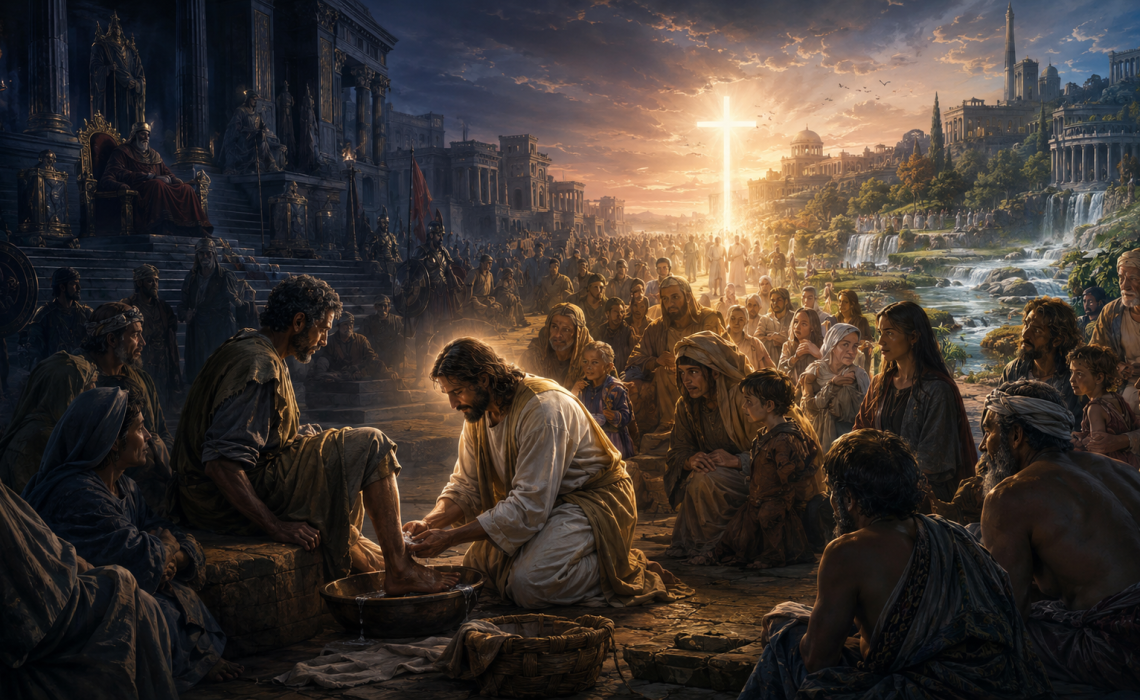
“The greatest among you should be like the youngest, and the one who rules like the one who serves.” Luke 22:26
When Christians hear the words church and politics, many immediately think of elections, political parties, public policy, or how believers should vote. In much of the modern world, especially in the West, political theology has often been reduced to finding Bible verses that appear to support positions we have already chosen. Christians across the political spectrum do this. They quote passages about loving our neighbour, caring for the poor, justice, freedom, or personal responsibility, often without paying close attention to the larger biblical story.
The problem is not that the Bible has nothing to say about politics. The problem is that we frequently use Scripture to support our agendas instead of allowing Scripture to shape them. Individual verses become slogans detached from their original context, and the Bible becomes a tool for defending our opinions rather than a story that transforms our imagination.
A truly biblical political theology asks much deeper questions. What is power for? Why were human beings given authority? Why does political power become corrupt? How does Jesus redefine kingship? And what does faithful citizenship look like for those who confess Jesus as Lord?
To answer those questions, we must begin where Jesus so often began: at the beginning of the biblical story.
Genesis opens with a world described as formless, empty, and covered in darkness. God confronts this chaos not with violence but with His word. He speaks, separates, orders, names, and fills creation with life. Light replaces darkness. Dry land emerges from the waters. Plants, animals, and human beings fill the earth.
The first picture of authority in the Bible is therefore profoundly important. God uses His power to bring order out of chaos so that life may flourish. Divine authority is creative, generous, and life-giving.
The climax of Genesis 1 comes when God declares, “Let us make mankind in our image, in our likeness, so that they may rule.” Humanity is created to be God’s image in creation.
In the ancient Near East, an image represented the presence and authority of a king. Kings placed statues of themselves throughout their kingdoms to signify their rule. Genesis makes the astonishing claim that God’s images are not statues of stone or metal. They are living human beings.
This means the image of God is not merely a quality we possess. It is a calling. Humanity is commissioned to represent God’s character and authority within His world.
Immediately after creating humanity, God commands them to rule and subdue the earth. These words have often been misunderstood as permission to exploit creation or dominate others. Yet their meaning must be understood in light of the way God Himself rules.
God rules by bringing life where there was chaos. Human beings are therefore called to exercise authority in exactly the same way.
A gardener provides a helpful picture. Left alone, a garden will grow, but it will also become overrun with weeds. The gardener does not create the soil, rain, sunlight, or seeds. Those are gifts. Instead, the gardener cultivates what already exists, directing its potential so that it produces greater abundance.
Human authority is intended to function similarly. We build homes, schools, hospitals, businesses, governments, and communities. At their best, these institutions create environments where people can flourish together.
Politics, understood this way, is not merely about elections or governments. It concerns the ordering of human life so that communities may thrive. Genesis therefore provides the Bible’s first political vision: authority exists to promote life.
Yet the story quickly takes a tragic turn.
Genesis 3 presents humanity with a choice. Will human beings trust God’s wisdom to define good and evil, or will they seize that authority for themselves?
They choose independence.
The consequences spread rapidly. Harmony becomes conflict. Marriage fractures. Cain murders Abel. Violence enters human society. Cities become centres of pride rather than blessing, culminating in Babylon, where humanity seeks to make its own name great instead of honouring God.
The problem is not authority itself. Humanity was created to exercise authority. The problem is authority detached from submission to God.
Whenever individuals, tribes, nations, or institutions define good and evil according to their own interests, power becomes destructive. Instead of creating life, it produces oppression, rivalry, violence, and death.
The Book of Exodus provides the Bible’s first detailed portrait of political power gone wrong.
The Israelites settle in Egypt and become numerous. Pharaoh sees them not as neighbours but as a threat. Fear reshapes his moral vision. He enslaves them, exploits their labour, and eventually commands that their sons be killed.
The security of his kingdom has become more important than the dignity of human beings.
When Moses demands Israel’s release, Pharaoh responds, “Who is the Lord, that I should obey him?”
His words reveal the essence of political idolatry. Pharaoh no longer sees himself as God’s servant. He believes he is answerable to no one.
God’s deliverance of Israel demonstrates that no earthly ruler possesses ultimate authority. Pharaoh falls, and Israel celebrates God’s kingship by singing, “The Lord reigns forever and ever.”
The Old Testament repeats this pattern. Egypt, Babylon, Persia, Greece, and later Rome all claim greatness. They establish order, yet eventually exalt themselves, exploit others, and become instruments of injustice.
Daniel captures this brilliantly through the image of beasts.
Humanity was created to rule over the animals, but kingdoms that reject God’s wisdom become beastlike. They devour rather than protect. They consume rather than cultivate.
This is humanity’s recurring political tragedy.
Against this background, Jesus appears announcing, “The kingdom of God has come near.” That announcement is unmistakably political. Jesus declares that God is reclaiming His world. Yet He does so in a way nobody expected. He gathers no army. He stages no revolution. He overthrows no government by force.
Instead, He gathers disciples and teaches them the values of an entirely different kingdom.
The Sermon on the Mount becomes the constitution of God’s reign.
In this kingdom, the poor in spirit are blessed. The meek inherit the earth. The merciful receive mercy. Peacemakers are called children of God.
Everything is reversed.
Worldly kingdoms celebrate wealth, dominance, prestige, and strength. Jesus celebrates humility, mercy, purity, forgiveness, and sacrificial love.
Greatness is measured by service.
Leadership is measured by humility.
Victory comes through faithfulness.
Jesus embodies these principles throughout His ministry. He welcomes sinners, heals the sick, honours children, restores the excluded, and confronts religious hypocrisy. He publicly challenges systems that burden the vulnerable while enriching the powerful.
His kingdom threatens existing powers precisely because it exposes them.
The climax comes in Jerusalem.
Jesus enters the city as Israel’s true King, cleanses the temple, and confronts both religious and political authorities. These actions ultimately lead Him to the cross.
The crucifixion is deliberately presented as an ironic coronation.
Jesus receives a crown, but it is woven from thorns.
He receives royal robes, but they are placed upon Him in mockery.
A sign proclaims Him king, even as He hangs dying.
His throne is a cross.
Here the Bible completely overturns humanity’s understanding of power.
Earthly rulers secure authority by sacrificing others.
Jesus secures His kingdom by sacrificing Himself.
The King conquers not by killing His enemies but by bearing their violence.
The resurrection vindicates His way. Human power does not have the final word. Death itself is defeated.
After rising, Jesus declares, “All authority in heaven and on earth has been given to me.”
Notice what follows.
He does not command His followers to establish His kingdom through force. Instead, He sends them to make disciples, baptise, teach, and embody His way of life among all nations.
The church becomes the visible community of God’s kingdom.
This creates a remarkable political paradox.
Christians proclaim that Jesus—not Caesar, not any emperor, president, parliament, or state—is Lord of the world.
Yet they refuse violent revolution.
The early church announced another King while refusing to imitate the violent methods of earthly kingdoms.
This tension appears throughout the Book of Acts.
Paul repeatedly faces accusations of sedition because he proclaims another king, Jesus. Yet the apostles never organise armed resistance. They preach, serve, heal, suffer, and bear witness.
Their confidence rests not in political control but in the resurrection.
This also explains Paul’s famous teaching in Romans 13.
“Let everyone be subject to the governing authorities.”
These words have often been misunderstood.
Paul is not claiming that every ruler is righteous or that every government action reflects God’s will. The same Scriptures repeatedly condemn corrupt kings and oppressive empires.
Instead, Paul argues that authority itself belongs to God.
Even imperfect governments can preserve social order and restrain greater chaos. Christians should therefore normally honour authorities, pay taxes, pray for rulers, and contribute positively to society.
Submission, however, is not absolute.
Daniel served Babylon faithfully, but he refused to worship its idols.
The apostles respected authorities but declared, “We must obey God rather than human beings.”
Whenever governments demand ultimate allegiance or require disobedience to God, Christians must resist.
Such resistance, however, follows the pattern established by Jesus.
It is courageous without becoming hateful.
It is truthful without becoming violent.
It is willing to suffer rather than inflict suffering.
Throughout Scripture we see this pattern repeatedly. Moses confronts Pharaoh. Nathan rebukes David. Elijah challenges Ahab. Daniel speaks truth to Nebuchadnezzar. John the Baptist confronts Herod. Jesus exposes corruption in Jerusalem.
The people of God have always practised prophetic witness.
Christians therefore possess dual citizenship.
We belong to earthly nations, yet our deepest identity lies elsewhere.
Our primary citizenship is in the kingdom of God.
This means our loyalty to Jesus always surpasses our loyalty to any nation, party, ideology, or political leader.
We may vote. We may serve in public office. We may influence legislation. We may advocate for justice.
Joseph served Egypt.
Esther influenced Persia.
Daniel served Babylon.
Each worked within imperfect political systems while remaining faithful to God.
These examples remind us that Christians need not withdraw from public life. Rather, they should enter it with a radically different vision of authority.
The goal is never domination.
The goal is service.
Political participation matters because laws, institutions, and policies affect real people created in God’s image.
Yet politics must never replace discipleship.
Casting a ballot cannot substitute for loving one’s neighbour.
Supporting worthy policies cannot excuse personal indifference.
It is possible to champion justice publicly while neglecting justice in our own homes, churches, and workplaces.
Jesus calls His followers to something deeper.
The primary political community He creates is the church.
Within the church, people of different races, classes, cultures, and nations become one family under one King.
They learn forgiveness instead of revenge.
Generosity instead of greed.
Service instead of domination.
Unity instead of tribalism.
This community becomes a living demonstration of God’s future kingdom breaking into the present world.
The New Testament also reminds believers that political struggles are never merely human.
Paul speaks of principalities and powers—spiritual realities that operate through human institutions and systems.
This does not remove human responsibility.
Rather, it reveals that behind pride, oppression, injustice, and idolatry lies a deeper spiritual rebellion.
Human communities continually elevate their own interests into ultimate values.
Nations glorify themselves.
Economies become objects of worship.
Political movements promise salvation.
Religious institutions sometimes confuse their own preservation with God’s kingdom.
Whenever something created claims ultimate allegiance, idolatry has appeared.
The Book of Revelation describes Babylon as both a city and a global economic, political, and spiritual system enriched by exploitation.
Its fall reminds believers that every human empire is temporary.
Only God’s kingdom endures.
This perspective guards Christians from placing ultimate hope in politics.
The Bible does not identify any earthly nation with the kingdom of God.
No government perfectly reflects God’s reign.
No political party embodies the gospel.
No election can usher in the new creation.
Christians may strongly support particular policies or leaders, but their hope cannot rest there.
Their confidence rests in the risen King.
This hope also transforms how believers live today.
They pursue justice without imagining they can create heaven on earth.
They serve faithfully without becoming cynical.
They challenge injustice without dehumanising opponents.
They seek peace while remaining committed to truth.
Above all, they remember that God’s kingdom advances not through coercion but through transformed lives.
The church’s mission is therefore not to seize power but to bear witness.
It announces that Jesus is already King.
It demonstrates His kingdom through communities shaped by mercy, generosity, holiness, forgiveness, and sacrificial love.
The biblical story begins with humanity commissioned to reflect God’s rule.
It ends with the risen Christ restoring that vocation.
He is the true human, the faithful King, and the perfect image of God.
Those who follow Him are called to exercise whatever influence they possess in the same way He exercised His authority: by serving others, defending the vulnerable, speaking truth, and giving themselves for the good of the world.
The kingdoms of this age continue to compete for our loyalty. They promise security, prosperity, identity, and significance. Yet every earthly kingdom is temporary, and every ruler is accountable to the One who reigns forever.
The question Christians must continually ask is not merely, “Which political programme do I support?” but, “How can I faithfully represent King Jesus where He has placed me?”
That question reshapes everything.
It reminds us that authority exists to serve rather than dominate, that greatness is found in humility rather than status, and that genuine power is revealed most clearly in sacrificial love.
The politics of Jesus is therefore not an escape from public life but a complete redefinition of it. His followers are called to live as citizens of heaven while faithfully serving on earth, bearing witness to the day when every empire will fade, every injustice will be judged, and every knee will bow before the true King whose kingdom alone will never end.
Discover more from NUN HRUAITU
Subscribe to get the latest posts sent to your email.