
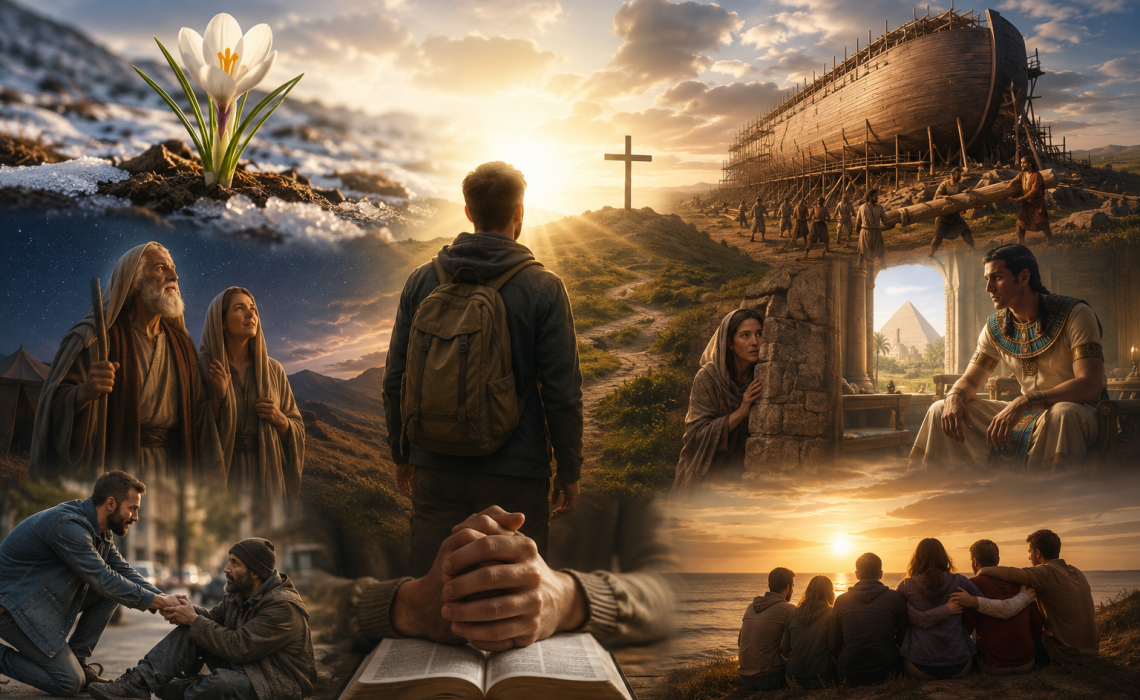
Faith is one of those words Christians use often, like grace, redemption, and salvation. Yet many of us rarely stop to ask what it truly means. Hebrews 11, often called the great chapter of faith, helps us understand it deeply.
Hebrews 11:1 says:
“Now faith is the assurance of things hoped for, the conviction of things not seen.” — Hebrews 11:1
The Greek word translated “assurance” can also mean substance, foundation, or reality. The word translated “conviction” can mean proof or evidence. So faith is not merely a feeling inside our minds. It is not pretending to be certain about something uncertain. Biblical faith is the present experience of a future reality promised by God.
Hebrews 11 is not mainly about people thinking religious thoughts. It is about people acting. Noah built an ark. Abraham left his homeland. Moses rejected the treasures of Egypt. Rahab welcomed the spies. Their faith became visible through obedience.
This means Christian faith is not blind faith. Blind belief without reason is not biblical faith. Sarah trusted God because He had already shown Himself faithful. Abraham reasoned that the God who gave him Isaac could even raise the dead. Their faith was rooted in God’s proven character.
Faith is like seeing the first flower after a long winter. Snow may still fall, but the flower is proof that winter will not last forever. In the same way, the resurrection of Jesus is the Christian’s great sign that sin, death, and evil will not have the final word. Because Christ has risen, we have reason to trust God’s promised future.
But faith must move beyond thought. A person may believe a chair can hold him, but he only truly trusts it when he sits down. Faith is the transfer of trust from ourselves to God. It is believing that He is faithful, and then living accordingly.
Living by faith means living now according to the values of God’s coming kingdom. Forgiveness, purity, humility, generosity, and love for enemies may look foolish in the present world. But if God’s new creation is coming, these are not foolish at all. They are signs of the future breaking into the present.
Doubt and questions are not enemies of faith. Honest questions can strengthen faith because Christianity is rooted in the historical life, death, and resurrection of Jesus. Faith does not ask us to stop thinking. It asks us to think deeply, trust rightly, and obey courageously.
Faith can therefore be described as believing loyalty. It is not just agreeing with ideas about God. It is remaining loyal to Him even when His timing differs from ours, even when prayers seem delayed, and even when we cannot see the full picture.
Jesus praised the faith of the Roman centurion in Matthew 8 because the man understood Christ’s authority. He believed Jesus could heal with just a word. That kind of faith was not mere emotion. It was confident trust in who Jesus is.
Biblical faith is reasoned trust expressed through obedient action. It begins with evidence, grows through obedience, and gives us a foretaste of God’s coming kingdom.
Faith is living today as though God’s promised future is already breaking into the present—because through the resurrection of Jesus Christ, it truly has.
Discover more from NUN HRUAITU
Subscribe to get the latest posts sent to your email.