
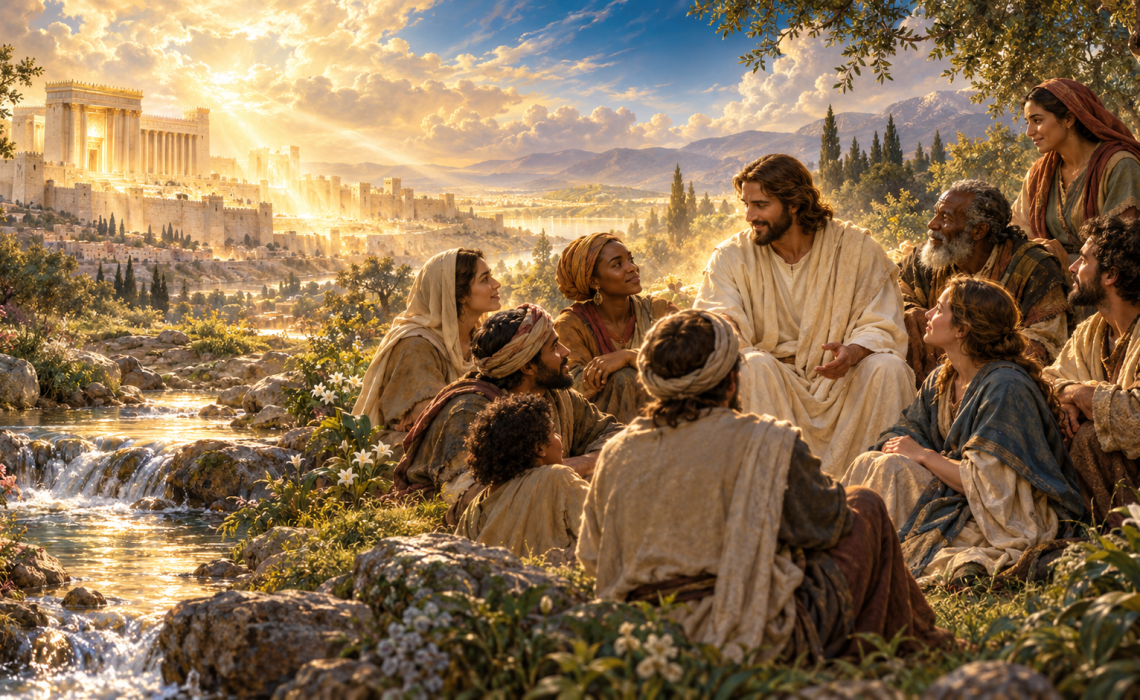
“If anyone loves me, he will keep my word, and my Father will love him, and we will come to him and make our home with him.” John 14:23
One of the most profound themes running through the Bible is God’s desire to dwell among His people. From the Garden of Eden to the Tabernacle, from Solomon’s Temple to the person of Jesus Christ, Scripture consistently portrays God moving toward humanity in loving fellowship. This theme reaches a remarkable climax in the Gospel of John, particularly in Jesus’ words during the Last Supper recorded in John 14.
For many Christians, Jesus’ statement, “In my Father’s house are many rooms” (John 14:2), immediately evokes images of heavenly mansions prepared for believers after death. While this interpretation has brought comfort to generations of Christians, a closer examination of the text, its Greek vocabulary, and its broader biblical context reveals a much richer and deeper meaning.
The Gospel of John differs significantly from the Synoptic Gospels—Matthew, Mark, and Luke. John presents Jesus through a highly theological lens, emphasizing His divine identity and mission. Chapters 13 through 17, which record Jesus’ final teachings before His crucifixion, contain some of the most profound reflections on the relationship between God, Christ, and believers.
When Jesus tells His disciples that there are “many rooms” in His Father’s house, the Greek word translated as “rooms” or “mansions” is mone, meaning a dwelling place or abode. Rather than describing permanent heavenly estates, the term carries the idea of a place of residence or temporary lodging. This linguistic detail invites readers to reconsider what Jesus may have intended.
The key to understanding the passage lies in the phrase “my Father’s house.” Earlier in John’s Gospel, Jesus uses the exact same phrase when cleansing the Temple in Jerusalem. There He declares, “Do not make my Father’s house a house of trade” (John 2:16). In that context, “my Father’s house” clearly refers to the Temple.
However, John immediately provides an important interpretation. After Jesus speaks of destroying the Temple and raising it again in three days, John explains that Jesus was actually speaking about the temple of His body (John 2:21). This revelation becomes a crucial interpretive lens for later passages.
If “my Father’s house” first refers to the Temple, and the Temple ultimately points to Jesus Himself, then Jesus’ words in John 14 take on a new dimension. Rather than merely describing future residences in heaven, He may be speaking about participation in the new Temple reality that He Himself embodies.
This interpretation gains further support later in John 14. Jesus tells His disciples, “If anyone loves me, he will keep my word, and my Father will love him, and we will come to him and make our home with him” (John 14:23). Significantly, the same root word used for “rooms” earlier in the chapter appears again here for God’s dwelling within believers.
The emphasis shifts from believers going somewhere to live with God toward God coming to dwell within His people. This is one of the central themes of John’s Gospel: mutual indwelling. The Father is in the Son, the Son is in the Father, believers are in Christ, and Christ dwells in believers through the Holy Spirit.
This theme reaches its fullest expression in Jesus’ prayer in John 17. There He prays that His followers may be united with Him and the Father in the same intimate fellowship that exists within the Trinity itself. The goal is not merely relocation to heaven but participation in God’s own life.
The Temple theme helps explain this mystery. Throughout the Old Testament, the Temple represented the place where heaven and earth overlapped, where God’s presence dwelt among His covenant people. Yet faithful Israelites understood that the physical Temple was only a symbol. Even Solomon, at the Temple’s dedication, acknowledged that “heaven and the highest heaven cannot contain” God (1 Kings 8:27).
The Temple pointed forward to a greater reality that had not yet arrived.
According to the New Testament, that greater reality arrives in Jesus Christ. John’s Gospel opens by declaring that the Word became flesh and “dwelt” among humanity. The language literally means that He “tabernacled” among them. Jesus becomes the true Temple, the ultimate meeting place between God and humanity.
This understanding extends even further. Through Christ’s death, resurrection, and the gift of the Holy Spirit, believers themselves become part of God’s dwelling place. The Apostle Paul repeatedly teaches this truth. In 1 Corinthians 3:16 he asks, “Do you not know that you are God’s temple and that God’s Spirit dwells in you?” Likewise, in 2 Corinthians 6:16, Paul declares, “We are the temple of the living God.”
The Apostle Peter employs similar imagery, describing believers as living stones being built into a spiritual house. Together, the church becomes the dwelling place of God on earth.
This Temple theology also illuminates other biblical images. Jesus’ reference to angels ascending and descending upon the Son of Man echoes Jacob’s vision at Bethel, where heaven and earth met through a ladder connecting both realms. In John’s Gospel, Jesus presents Himself as the true Bethel—the ultimate meeting point between God and humanity.
The ancient Temple, Jacob’s ladder, the Tabernacle, the Garden of Eden, and the cosmic mountain all converge in Christ. He is the fulfillment of every symbol of divine presence found throughout Scripture.
Yet the story does not end with Jesus alone. Through union with Christ, believers participate in this sacred reality. They become temples of the Holy Spirit and members of Christ’s body. Sacred space is no longer confined to a building in Jerusalem. It exists wherever God’s Spirit dwells within His people.
This truth carries profound ethical implications. If every believer is a dwelling place of God, then fellow Christians must be treated with dignity, honor, and reverence. Just as ancient Israelites would never casually defile the Temple, Christians are called to respect one another as sacred spaces inhabited by God’s presence.
Ultimately, whether one interprets John 14 primarily as a promise of heavenly dwelling places or as a description of God’s indwelling presence, the central message remains the same: God desires to live among His people. The Temple has moved from stone buildings to living persons. Through Jesus Christ, heaven and earth have begun to overlap once again.
The great hope of the Christian faith is not merely that believers will someday go to God’s house. It is that God has already begun making His home among His people. The promise of Scripture is that this divine-human fellowship will continue until the day when God’s dwelling is fully established with humanity in the new creation, and the presence that once filled the Temple will fill all things forever.
Discover more from NUN HRUAITU
Subscribe to get the latest posts sent to your email.