
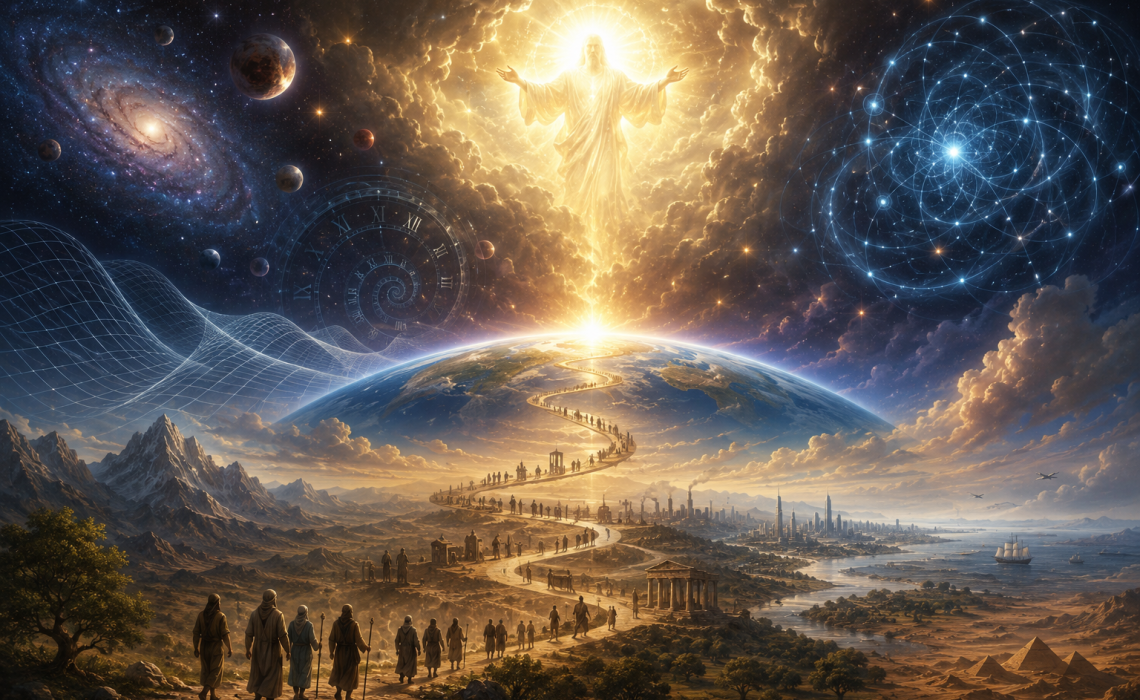
The Bible is not a science textbook. It was not written to explain relativity, quantum mechanics, cosmology, or the nature of spacetime. Yet one of the most fascinating aspects of modern physics is how some of its discoveries seem surprisingly compatible with certain biblical descriptions of God.
Over the last century, science has radically changed our understanding of reality. According to Einstein’s theory of relativity, space and time are not separate entities but part of a unified fabric known as spacetime. Time is not an absolute backdrop against which events unfold. It is woven into the structure of the universe itself.
More recently, some theoretical physicists have proposed that spacetime may not even be fundamental. Emerging research in quantum gravity suggests that spacetime could arise from deeper quantum relationships, particularly quantum entanglement. While these ideas remain speculative, they raise a profound question: if spacetime itself is part of creation, what would it mean for God to exist beyond it?
Interestingly, the Bible contains several passages that seem remarkably consistent with such a possibility.
The first appears in the opening verse of Scripture:
“In the beginning God created the heavens and the earth.” (Genesis 1:1)
For ancient readers, this statement simply affirmed that God created everything. However, from a modern perspective, it carries an additional implication. If God created all that exists, then God also created time itself.
Modern cosmology suggests that time began with the universe. According to the standard Big Bang model, asking what happened “before” the beginning of the universe may be meaningless because time itself came into existence with the cosmos. If that is true, then the biblical picture of God existing before creation is not merely describing a being who existed a very long time ago. It describes a being whose existence is independent of time altogether.
The Bible repeatedly portrays God as relating to time differently from human beings.
Psalm 90:4 declares:
“For a thousand years in your sight are but as yesterday when it is past.”
Similarly, the apostle Peter writes:
“With the Lord one day is as a thousand years, and a thousand years as one day.” (2 Peter 3:8)
These verses are not intended as mathematical formulas. Rather, they emphasize that God’s experience of reality is fundamentally different from ours. Human beings live moment by moment. We remember the past, experience the present, and anticipate the future. God, however, is portrayed as transcending these limitations.
This idea becomes even more intriguing when viewed through the lens of relativity. Einstein showed that time does not pass at the same rate for all observers. Different observers moving at different speeds or experiencing different gravitational fields can measure time differently. While relativity does not prove God’s existence, it does demonstrate that time is not the absolute and universal reality many people once assumed it to be.
The Bible also presents God as seeing the entirety of history at once.
In Isaiah 46:10, God says:
“I make known the end from the beginning.”
Likewise, in Revelation, God declares:
“I am the Alpha and the Omega, the beginning and the end.” (Revelation 22:13)
These statements suggest more than extraordinary foresight. They imply a perspective from which all of history is visible simultaneously. Christian philosophers have often compared this to viewing an entire film reel at once while human beings experience only a single frame at a time.
This concept bears a striking resemblance to what physicists sometimes call the “block universe” interpretation of spacetime. In this view, past, present, and future are all equally real parts of a four-dimensional structure. Human beings move through this structure sequentially, but the structure itself exists as a whole.
Again, the Bible is not teaching physics. Yet the biblical description of God appears surprisingly compatible with such a picture.
Another significant passage comes from King Solomon’s prayer at the dedication of the Temple:
“The heaven and heaven of heavens cannot contain You.” (1 Kings 8:27)
This statement emphasizes that God cannot be confined within creation. The universe is not God’s container. Rather, God is the creator and sustainer of the universe.
If spacetime is part of creation, then God cannot be merely another object located somewhere within spacetime. Instead, He would exist beyond and independent of the very framework in which physical reality unfolds.
The divine name revealed to Moses points in a similar direction.
When Moses asks for God’s name, the response is:
“I AM WHO I AM.” (Exodus 3:14)
For many theologians, this phrase emphasizes God’s eternal and self-existent nature. God does not become. God simply is.
This understanding profoundly influenced thinkers such as Augustine and Thomas Aquinas. Aquinas argued that God does not experience time the way creatures do. Rather than existing through an endless sequence of moments, God exists in what he called an “eternal now,” possessing all reality simultaneously.
Modern discussions about quantum gravity introduce yet another intriguing possibility. Some physicists, including Juan Maldacena and Leonard Susskind, have explored theories suggesting that spacetime itself may emerge from networks of quantum entanglement. If future discoveries confirm that spacetime is not fundamental but emergent, the biblical picture becomes even more philosophically compelling.
The Bible consistently portrays God as the source not merely of matter and energy, but of all created reality. If spacetime emerges from something deeper, then God would stand beyond that deeper level as well.
Perhaps the most striking biblical statement is found in Psalm 90:
“Before the mountains were brought forth, or ever you had formed the earth and the world, from everlasting to everlasting you are God.”
Notice what the verse does not say. It does not describe God as existing within an infinitely long timeline. Instead, it places God outside the created order altogether.
For that reason, while Scripture never mentions relativity, quantum mechanics, or spacetime, it presents a vision of God that fits remarkably well with one of modern science’s most profound discoveries: time itself may be part of creation. And if time is created, then the Creator must stand beyond it.
The Bible’s central claim is not that God is older than the universe. Its claim is far more radical: God is the reason the universe—and therefore space, time, matter, and energy—exist at all.
Discover more from NUN HRUAITU
Subscribe to get the latest posts sent to your email.